.svg)
.svg)

.svg)


Spray Foam Insulation Cost in Louisiana: 2026 Pricing Breakdown
Understanding the spray foam insulation cost Louisiana homeowners face is the first step when budgeting any home improvement upgrade in the Gulf South. For local homeowners looking to combat rising utility bills and intense summer heat, understanding the upfront investment of high-performance thermal design is essential.
While traditional insulation options may seem cheaper initially, they often fail to provide a complete air and moisture seal. Investing in a professional spray foam cost Louisiana upgrade offers a specialized solution engineered to withstand our specific climate.
By breaking down the modern financial landscape of spray foam, you can easily determine how this efficient upgrade fits into your long-term property budget.
The Core Numbers: Cost Per Sq Ft in the Local Market
The overall cost of a spray foam project is influenced by several variables, including the configuration of your layout, ease of access, and the overall thickness required to hit optimal thermal targets. In the 2026 market, professional installation rates generally follow a consistent baseline based on the exact material selected.
Comparing Open-Cell and Closed-Cell Expenses
- Open-Cell Spray Foam: This flexible, high-expansion material typically ranges from $1.50 to $3.00 per square foot. It is highly cost-effective for general air sealing in residential attics and deep interior wall cavities.
- Closed-Cell Spray Foam: This dense, rigid, and completely waterproof material ranges from $1.75 to $4.50 per square foot. Because it functions as a premium vapor retarder and adds structural strength, it is highly recommended for damp crawl spaces and roof decks.
Budgeting for Project Scale
For a standard single-family property needing targeted coverage, overall project quotes usually fall between $2,200 and $6,500. Smaller, isolated retrofits like a standard crawl space encapsulation sit on the lower end of the spectrum, while comprehensive, whole-home insulation deployments scale higher due to material volume.
To see how alternative applications hold up against these numbers, you can read more about blow-in traditional fiberglass insulation costs and why traditional options often demand hidden long-term maintenance fees.
Measuring Value: Real-World ROI Timelines
Evaluating the true value of your initial layout requires looking closely at the return on investment (ROI) timeline. Unlike traditional batts that sag and degrade, a premium foam installation acts as a permanent structural addition that pays dividends from day one.
Most homeowners in Louisiana witness an immediate 30% to 40% reduction in their monthly cooling and heating expenditures. In our intense climate, where air conditioners run heavily for up to nine months out of the year, these monthly savings compound rapidly.
Long-Term Financial Protections
- Extended HVAC Lifespan: Lowering the thermal stress on your cooling system preserves your expensive mechanical components, delaying costly replacements.
- Avoided Remediation Expenses: The superior moisture protection delivered by closed-cell foam actively prevents costly wood rot and mold remediation.
- Increased Property Equity: Modern homes outfitted with certified, airtight thermal envelopes maintain higher market valuations and attract energy-conscious buyers.
Given these continuous operational savings, the typical timeline to completely recover your initial installation costs spans just 3 to 5 years, leaving you with pure financial savings for the remaining life of the building.

Accessible Financing Options and Modern Rebates
You do not have to cover the entire cost of your energy upgrade out of pocket. There are several modern financial pathways designed to make high-performance insulation accessible for any household budget.
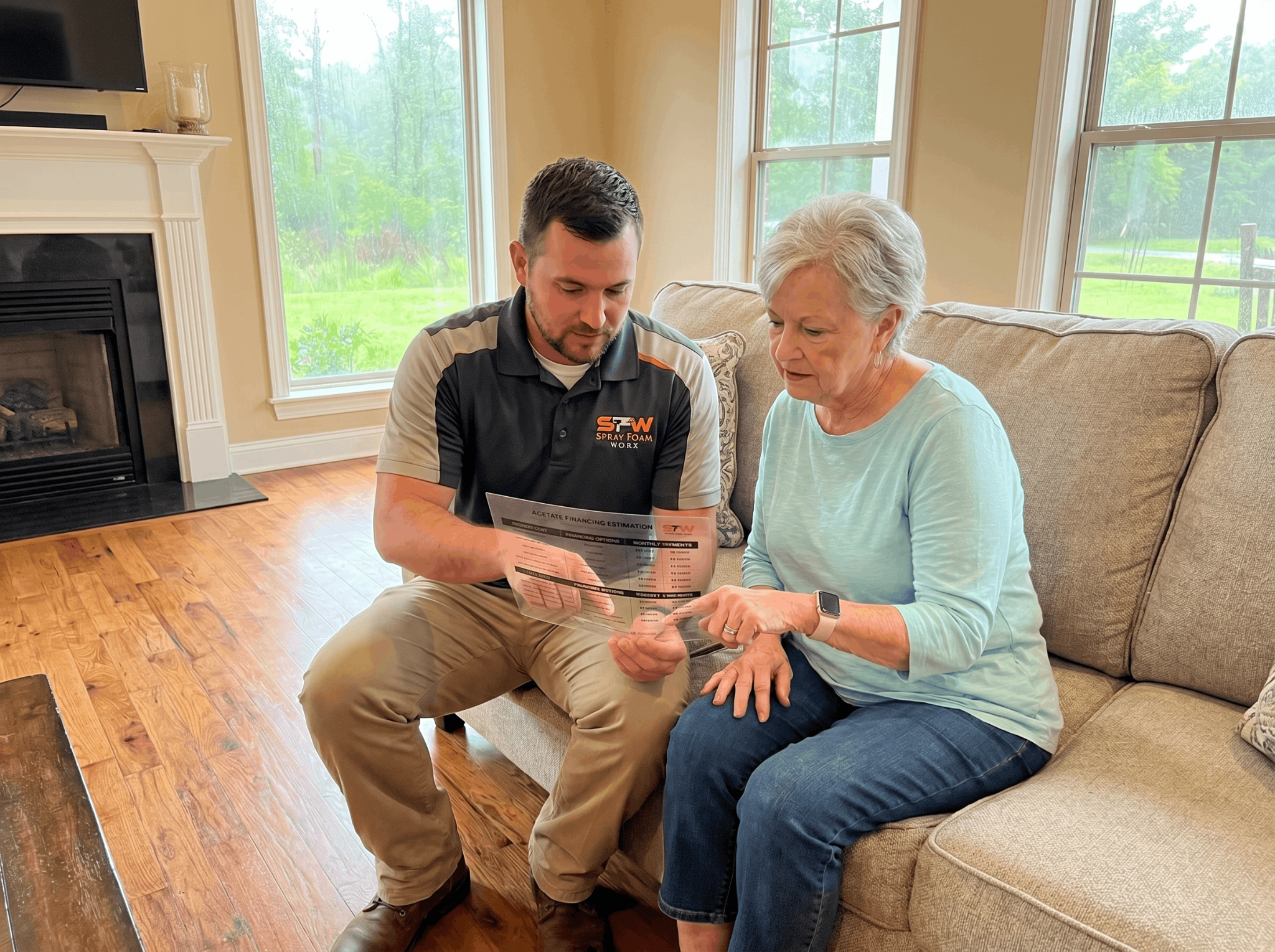
Many property owners leverage local energy efficiency loans or low-interest financing programs offered directly through certified installation networks. These structural programs often feature flexible monthly payments that are offset by the immediate drop in your monthly electricity bills.
Government Incentives and Tax Breaks
Furthermore, under current federal energy incentives detailed by the U.S. Department of Energy and ENERGY STAR, homeowners can claim substantial tax credits for qualifying insulation upgrades. Under the IRS Section 25C Energy Efficient Home Improvement Credit, these provisions can subtract up to 30% of your qualifying insulation material costs off your federal tax liability, drastically lowering the net investment required to seal your home. Always confirm current eligibility and credit limits with a tax professional, as federal program terms are subject to change.
To understand why this premium environmental upgrade is worth funding, explore the foundational structural benefits behind why spray foam dominates traditional insulation methods.
Balancing the Prep Work: Old Material Removal
When calculating your comprehensive budget, it is important to factor in the state of your current attic or subfloor. If your home has old, water-damaged fiberglass or contaminated cellulose, spraying new foam directly over it is counterproductive.
The Prep Work Investment
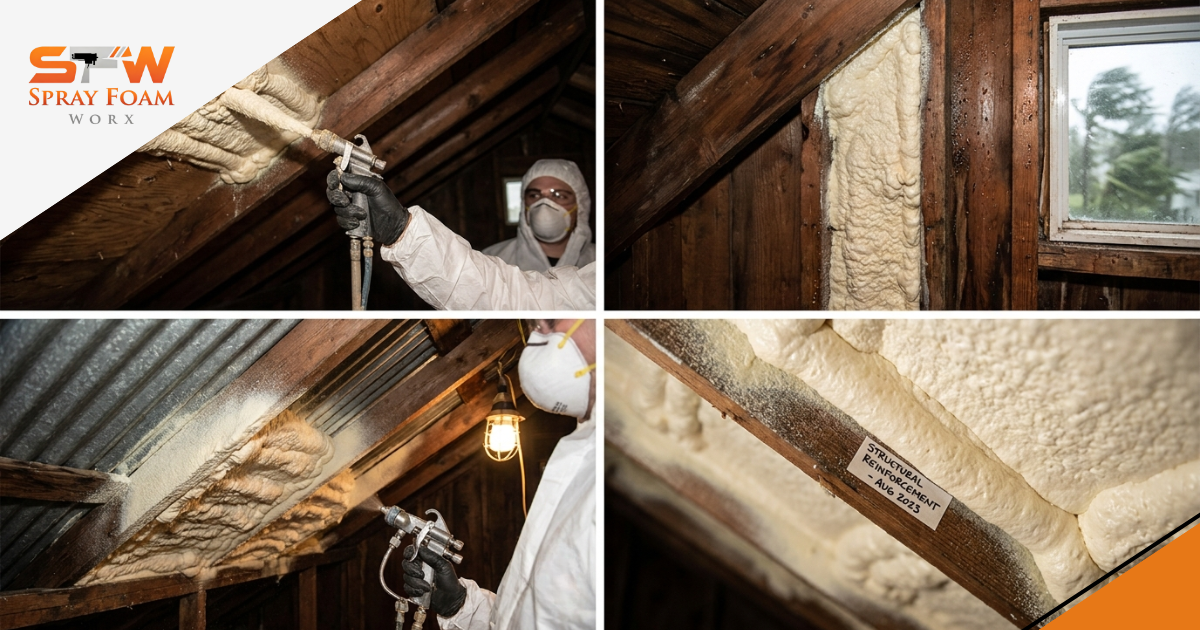
Clearing out failing traditional insulation ensures the polyurethane foam creates a flawless, permanent bond with your wood framing. This step matters even more in Louisiana, where average relative humidity hovers around 75–90% year-round and old fiberglass or cellulose tends to trap moisture, harbor mold, and hide hurricane-driven water intrusion long after a storm passes. Removing that compromised material before spraying protects both the new thermal boundary and your indoor air quality.
While clearing out old, saturated insulation adds a minor labor fee to the initial quote, it guarantees the safety and performance of your system. Prep costs also vary by parish and metro: removal and disposal in New Orleans and Lafayette typically run higher than in Shreveport, owing to coastal labor rates, stricter post-storm debris-handling rules, and tighter attic access in older Acadiana and Crescent City homes, while Baton Rouge generally lands in the middle of that range.
Partnering with a specialized team that offers high-powered vacuum insulation removal services ensures your home is safely prepared for its new system without making a mess.
Choosing Between Foam Densities for Maximum Value
To extract the absolute highest value out of every dollar spent, matching the proper foam density to your specific structural needs is a vital step in the planning phase.
Strategic Attic Sealing
For deep attic roof decks, open-cell foam expands massively to seal complex architectural joints easily, offering maximum R-value coverage per dollar. In Louisiana attics that routinely exceed 130°F during summer, that expansive air seal is what stops conditioned air from escaping and keeps your HVAC from running nine months a year. Because open-cell is the more economical density, it is often the budget-friendly entry point for inland homeowners in metros like Shreveport and Baton Rouge, where flood and wind-uplift exposure is lower than on the coast and per-square-foot pricing tends to sit at the affordable end of the range.
It excels in vented or semi-conditioned attic assemblies away from direct moisture contact, sealing the framing cavities and ridge joints common in North and Central Louisiana construction.
To see if this economical choice fits your layout, view the full capabilities of open-cell spray foam insulation.
Hostile Environment Defense
For exposed crawl spaces, coastal walls, or hurricane-prone roof lines, upgrading to closed-cell foam is the safest financial move. Its complete resistance to moisture and wind-uplift ensures your home remains structurally sound through severe weather seasons. This matters acutely in Louisiana, where Gulf humidity stays near 75–90% and the state averages roughly five to six named-storm threats per Atlantic hurricane season.
Closed-cell foam doubles as a vapor retarder and adds racking strength to the structure, which is why it is strongly favored for coastal and low-lying homes in New Orleans and Lafayette. Those markets typically carry the highest per-square-foot pricing in the state, reflecting strict wind-zone building codes, flood exposure, and elevated coastal labor rates, whereas inland Shreveport and Baton Rouge projects generally cost less for the same density. For storm-exposed parishes, that premium buys measurable resilience against wind-driven rain and moisture intrusion.
Review these advanced structural benefits by reading about closed-cell spray foam insulation applications.
Secure Your Custom Energy Estimate
Calculate Your Savings Instantly
Planning your home improvement budget shouldn't be guesswork. Use our interactive tool to estimate your project requirements and potential utility savings:
👉 Try the Spray Foam Worx Calculator & Quote Generator

FAQ
How much is spray foam insulation per square foot?
Local projects are priced per square foot, and in the 2026 Louisiana market most installations run from roughly $1.50 to $4.50 per square foot depending on the material. Open-cell foam typically falls between $1.50 and $3.00 per square foot for general air sealing, while denser closed-cell foam ranges from $1.75 to $4.50 per square foot for moisture-prone areas. The exact rate per square foot shifts with your target R-value, the thickness applied, and how accessible the space is. For localized residential ventures, calculating specific spray foam cost Louisiana layouts via thickness remains the industry norm.
How much does 1500 sq ft of insulation cost?
For a 1,500 square foot layout, open-cell retrofits typically average between $4,125 and $9,750 depending on structural accessibility and target R-value thickness. Upgrading that same area to a heavy-duty closed-cell system usually ranges between $4,725 and $11,250 due to the raw density of the product. The final project estimate can also vary based on whether your home requires old material removal first.
What are the negatives of spray foam?
The main drawbacks are the higher initial upfront cost compared to traditional fiberglass and the strict requirement for certified professional installation. If applied improperly by an untrained contractor, off-ratio mixtures can lead to lingering chemical odors or uneven structural expansion. Partnering with a proven crew like Spray Foam Worx eliminates these risks completely through specialized chemical monitoring and calibrated application setups.
What time of year is insulation cheapest?
Insulation services are frequently most accessible during the late winter and early spring months when regional construction activity naturally slows down. Homeowners who plan their upgrades during these off-peak periods can often take advantage of flexible scheduling windows and competitive seasonal pricing. Waiting until the extreme summer heat waves hit typically means navigating higher demand schedules across the local market.
What's better, spray foam or insulation?
Spray foam represents a major evolutionary leap over traditional insulation alternatives like fiberglass batts or cellulose sheets. While classic materials merely slow down heat transmission, spray foam establishes a completely solid air barrier, fills structural gaps, and blocks vapor movement simultaneously. This three-in-one performance delivery provides far greater structural protection, healthier indoor air quality, and superior long-term utility savings.
How long does spray foam insulation last?
When mixed and applied correctly by certified professionals, a high-performance spray foam deployment is designed to last for the entire life of the building. Polyurethane foam is a stable material that does not sag, settle, crack, or lose its operational thermal properties over time. Investing in a professional spray foam upgrade is a true "one-and-done" modification that permanently protects your home envelope.